Sound Off in the Forum

All reviews and site design © by Thomas M. Wagner. SF Reviews.net logo by Charles Hurst. All rights reserved. Book cover artwork is copyrighted by its respective artist and/or publisher.


AMERICAN GODS
2001

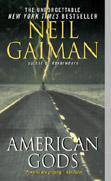
Book cover art by Kamil Vojnar (left).
Review © 2001 by Thomas M. Wagner.
AUTHOR'S SITE

Bookmark and Share

Neil Gaiman's career has followed a trajectory perhaps unique in modern popular fiction. Starting out in the arguably undignified realm of comic books, Gaiman made his mark writing dark and dreamlike stories for the sleeper DC Comics hit The Sandman. Gaiman's work was often guilty of style over substance, but in comics, that's just fine, especially for Gaiman, whose style is so rich in nightmarish imagery and ironic wit that it has caused a great many people to embrace him as the best writer in America today. I don't think Neil's quite that good, though he is a talented and immensely readable writer. But happily for him, this talent has been enough to earn Gaiman a reputation that has overcome any possible stigma attached to writing for comics. Other comic book writers, like Peter David and Chris Claremont, have gone on to write books, but they are generally dismissed as hacks, while Neil is feted by Hollywood moguls and fawned over by critics and colleagues.

I enjoyed reading American Gods, make no mistake — but to be honest, this compellingly grim modern fantasy is good but not great. Like much of Gaiman's Sandman work, it relies upon eerie atmosphere and metaphysical weirdness to carry readers through the fact that it has one of the most meandering plots you're likely to find in any modern fantasy. In American Gods, Gaiman both romanticizes and satirizes America in a way only a European can. His story is like a mutant marriage between Wim Winders (whose films Paris, Texas and Alice in the Cities are classics of "America through a European's eyes" romanticism), Jack Kerouac, and Clive Barker, with a healthy dollop of comic book sensibilities thrown in as a nod to Gaiman's roots. Indeed, Gaiman's entire premise deals with European gods — and what is a god but a superhero, or supervillian, after all? — uprooted and transplanted to America; what bolder way to try to "find" America, than through the eyes of a lost god?

The plot: Shadow (even the characters' names are iconographic) is a young man facing imminent release from prison after doing three years for assault. Genuinely rehabilitated, he looks forward to starting life anew with his wife and a job at a gym. But when, on the eve of his release, he learns his wife has been killed in a freak automobile accident, Shadow finds himself both literally and figuratively cast out into the unknown. Immediately he meets a strange fellow who identifies himself only as Mr. Wednesday, who makes him the proverbial offer he can't refuse. Shadow begins working as a bodyguard for Mr. Wednesday, about whom there is clearly More Than Meets the Eye.

Wednesday is in fact the god Odin, reduced to a trivial existence as not much more than an ultra-suave grifter by the fact that his believers, having brought him over to America hundreds of years ago, have now all vanished. Shadow meets numerous other gods of ages and religions past, all of whom are being pushed aside by America's new gods, which are, of course, television, the Internet, rampant consumerism, etc. Even Jesus isn't sacred enough; despite His prominence in America, Wednesday tells of how He was seen hitchhiking along a lonely road in Afghanistan. "It all depends on where you are." It's not exactly a subtle satirical point; indeed, Gaiman hammers it home most brazenly in a scene where Lucille Ball talks directly to Shadow from the TV set (even offering to show her boobs). Outlandish as they are, Gaiman is able to pull off these scenes because he writes them with a quiet confidence that overcomes their innate kitsch simply by acknowledging it.

Wednesday is determined that the old gods should not go down without a fight, and drags the hapless Shadow around the country as he attempts to recruit any and all of these dispossessed deities he can find for the upcoming "storm" that threatens to burst any moment. But the new gods have formidable fighters on their own side, employing comical men-in-black type thugs to menace Shadow at every turn.

As you might have guessed by now, it can be hard to tell when American Gods is putting you on and when it's really being a lyrical rumination on the importance and consequences of mythology to a culture. Often it's both at once. And though the novel is often extremely enjoyable to read, its patchwork, vignette-driven plot can seem aimless at times. Like many of the road movies from which Gaiman appears to be drawing some of his inspiration, American Gods is more about the journey itself than what might lie at the destination. And like a long road trip, parts of it are wondrous and beautiful, and other parts monotonous. Gaiman doesn't carry the magic consistently through to the story's end, but on the whole, the book offers enough moments of the truly mystical and bizarre that fans of his from the Sandman days should feel amply satisfied. Shadow grows into a sympathetic character, and many individual scenes in the book have the verisimilitude of the best work of Stephen King, while other scenes seem as if they'd be more at home in, well, a graphic novel.

Like the country it panegyrizes, American Gods is a beautiful, flawed, frustrating and unforgettable place to be. And that may be its final charm. Love it or hate it, you're not likely to read anything else like it — at least, not in this world.